

On April 11, 1961, the entire world’s attention was riveted on the Beit Ha’am building in Jerusalem. Adolf Eichmann, a Nazi lieutenant colonel and one of the key SS and Gestapo officers responsible for carrying out the “final solution of the Jewish question,” was seated in a bulletproof glass booth. When the prosecutor, Attorney-General Gideon Hausner, stood up to deliver his momentous opening statement, in which he coined the immortal words, “Standing with me here, at this hour, are six million prosecutors,” his words resonated far beyond the courtroom.
However, to ensure that the world could understand the testimonies of over 100 Holocaust survivors and the court could conduct proper legal proceedings against the defendant and his attorney, Dr. Robert Servatius (both of whom spoke only German), unprecedented logistical and linguistic operations were required. Behind the scenes of this landmark judicial drama was Hever Translations, a new venture founded only three years earlier. Hever Translation’s involvement in the Eichmann trial is not only a testament to Israeli innovation in the translation industry, but also a personal story of triumph of the spirit.
The shadow of Auschwitz looming over the interpreters, and Aliza Goldman’s personal triumph
In order to grasp the magnitude of the task delegated to Hever Translations, one should first become acquainted with the woman who founded the company. The late Aliza Goldman (OBM), who passed away at the age of 94, founded the company with her husband in 1958.
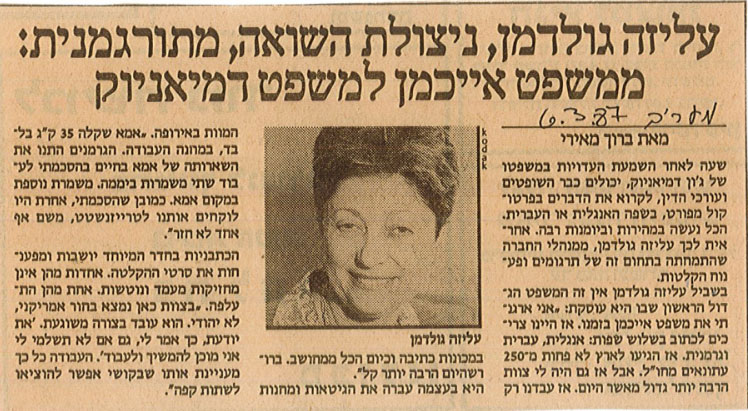
For Aliza Goldman, the Eichmann trial was not just a professional challenge – it was a return to the inferno. Her family was murdered during the Holocaust (apart from her mother, who was rescued from a labor camp weighing only 35 kg.), while Aliza herself had to constantly hide and flee to escape capture and imprisonment in the Ravensbrück concentration camp. In 1961, just over a decade after immigrating to Israel, Aliza Goldman was managing the recording, transcription and simultaneous interpretation operations during the trial of the man responsible for exterminating her people.
Members of the Goldman family say that it was difficult for Aliza to listen day after day to Eichmann and to the witnesses’ testimonies about the horrors he perpetrated, but she remained steadfast in her professional commitment to ensure impeccable translations of this historic trial.
Her son, Ron Goldman, recalls: “I remember that my mother simply “disappeared” and my parents hired a nanny for my brother and me who took care of us 24/7. We nicknamed her “Esther the wicked.” Throughout the years, my parents (and especially my mother) were very proud of having come up with the idea of transcribing and translating the trial. Exactly like a present-day startup.”
This idea provided the catalyst for the launch of Hever Translations.
Aliza Goldman conducted logistical operations that would be unimaginable today without modern technology. Under her management, 250 typists were brought to Israel from abroad to type the trial minutes on typewriters – in real time – in four languages – Hebrew, English, French and German.
The technical and linguistic challenge of simultaneous interpretation at 200 words per minute
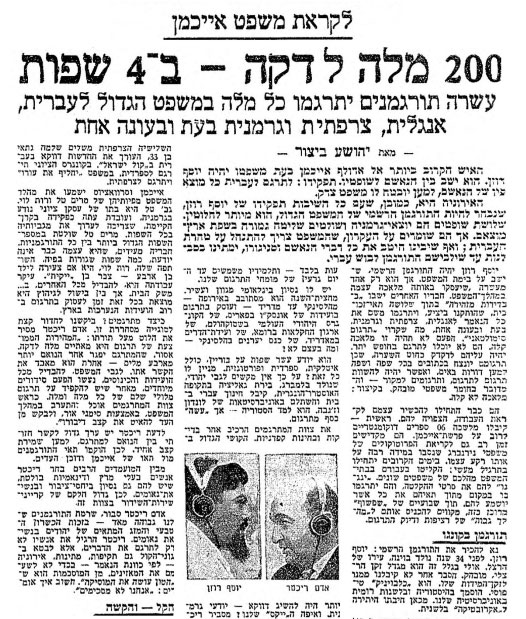
In the early 1960s, the profession of simultaneous interpretation in Israel was in its infancy. Adam Richter, the chief interpreter and head of the team of interpreters hired for the project, meticulously screened candidates to form a team of ten official interpreters and hired another ten interpreters as a reserve. One requisite standard was particularly high: 200 words per minute. The interpreters, who sat in glass cubicles in the gallery positioned in front of Eichmann’s glass booth and the witness stand, were tasked with simultaneously interpreting everything said during the trial into Hebrew, English, French and German. The interpreters were issued a strict rule: they must not lag behind the speaker by more than four words, so as not to lose the train of thought or continuity with the speaker.
Think about it for a moment. There were no computers, certainly no artificial intelligence and practically no automated means for tracking what was being said during this immensely important trial. Everything depended on human capabilities and precision organization of this complex array of operations.
The interpreters had to contend with major linguistic disparities in real time during the trial:
- German syntax: One of the main difficulties during simultaneous interpretation derives from German syntax (spoken by Eichmann and his defense attorney). For example, decisive verbs are often at ends of sentences and the word “nicht” also appears at ends of sentences to negate the entire sentence. The German interpreters often found themselves waiting in suspense for the end of a long sentence to find out whether the speaker’s intention was positive or negative before they could translate it into the other languages and still not lag behind.
- French verbosity: While Hebrew is concise (thanks to inflections of verbs and nouns enabling, for example, 200 words in English to be accurately translated into Hebrew using only 150 words), French tends to be verbose. The French interpreters had to work furiously to keep pace with the succinct Hebrew being spoken during the trial.
- Yiddish linguistics: Yiddish was the mother tongue of dozens of Holocaust survivors who opened their hearts during their testimonies. Interpreting Yiddish was particularly challenging, not because of the vocabulary, but because Yiddish speakers use fluid syntax and rely on linguistic individualism, facial expressions and intonation. Translating emotionally-charged spoken Yiddish into the rigid syntax of French or English legalese was a task that required unique skills.
Seated between the judges on the bench and the defendant was Yosef Rosen, the official simultaneous interpreter for the Hebrew language. Although the three judges were fluent in German, the court insisted that the trial be conducted in Hebrew. Rosen served as the conduit through which the testimony of this major war criminal and the arguments of his defense attorney were conveyed to the Israeli public, a role that required surgical precision and complete mastery of complex legal and bureaucratic terminology.
Police Bureau 06 and 275 hours of interrogation
Even before the trial began, Hever Translations performed an enormous transcription and translation assignment. The Eichmann interrogations by Police Bureau 06 Commander Avner Less continued over a period of nine months and yielded 275 hours of recordings on 44 audio reels.
Transcribing and translating these materials produced 3,564 typewritten pages. The accuracy of the translations was so critical to admissibility as evidence that copies were given to Eichmann himself, who compared them word for word with the recordings, made any corrections in the margins and signed each page. Later, during the trial itself, Eichmann’s handwriting on the trial minutes was compared forensically with his handwriting in transcripts of his memoirs and in other incriminating documents seized in Argentina. These handwriting analyses provided conclusive proof of Eichmann’s active involvement in mass murder and refuted his claim that he was merely a “cog” in the bureaucratic system. This exemplifies how Hever Translations’ impeccable transcriptions and translations during the Eichmann trial were included among the forensic evidence used to administer justice.
During the trial, the original court minutes underwent a rigorous quality control process, including comparing the court stenography output against audio tapes recorded by Kol Israel, the Israeli national radio service, before the presiding judge approved the minutes at the end of each session This process yielded the volumes of court records that were later published and more than 600 hours of audio recordings that are preserved in the State Archives.
Hever Translations’ legacy
Hever Translations’ team of simultaneous interpreters and transcribers were cognizant of the magnitude of their professional responsibilities during this live recording of history. The results of their work translating and transcribing the trial minutes into four languages were used by foreign newspaper journalists, in televised reports and in wireless communications opened for the first time between Tel Aviv and London. Hever Translations considered its mission to be both a national and international imperative, as a bridge that enabled the entire world to be exposed to the truth about the Holocaust and to the testimonies of survivors.
The uncompromising standards set during the trial shaped the future of Hever Translations and of the Israeli translation industry as a whole. Hever Translations’ resounding success during this project positioned it as Israel’s leading company for managing complex, sensitive and confidential events. As a result of the high esteem earned by Aliza Goldman and her team, Hever Translations has since been called upon repeatedly to provide its professional services during momentous events in the State of Israel, including during the trial of the Nazi war criminal John Demjanjuk (“Ivan the Terrible”), the deliberations of the Agranat Commission of Inquiry after the Yom Kippur War, the signing ceremonies of Israel’s peace agreements with Egypt and Jordan, and the Shamgar Commission of Inquiry investigating the assassination of Prime Minister Yitzhak Rabin (a project for which Hever Translations was issued “top secret” security clearance).
In retrospect, the Eichmann trial fundamentally transformed global awareness of the documented and authenticated atrocities committed during the Holocaust. Hever Translations’ meticulous precision during nearly two years of transcriptions, simultaneous interpretations and translations of the police interrogations, of Eichmann’s testimonies, of witness testimonies and of the arguments of the prosecutor and defense attorney played a decisive role in preserving the truth about the Holocaust. As the late Aliza Goldman said about her work over the years, her dedication to the translation field stems from her profound passion about ensuring that the truth is heard, documented and understood in every language for the sake of future generations.